Author Archives: kelleypayne

Updated town hall schedule

Dear Friends and Neighbors,

Thank you to everyone who planned to attend this week’s town halls in Bonney Lake and Edgewood. I truly appreciate you taking time out of your busy schedules to stay engaged.

Unfortunately, I lost my voice due to illness and had to cancel those meetings. I know it’s not easy to rearrange your time, and I appreciate your understanding. The good news is both events are now rescheduled for next week.

Rescheduled town halls:

  • Edgewood: Monday, April 27 | 6–8 p.m. | Edgewood City Hall, 10440 Dom Calata Way E.
  • Bonney Lake: Thursday, April 30 | 6–8 p.m. | Bonney Lake Senior Center, 19304 Bonney Lake Blvd. E.

The other previously scheduled town halls will take place as planned:

  • Buckley: Tuesday, April 28 | 6–8 p.m. | Buckley Hall, 127 N. River Road, Suite 117
  • Orting: Wednesday, April 29 | 6–8 p.m. | City of Orting Multi-Purpose Center, 202 Washington Ave. S.

I look forward to seeing you at one of these upcoming town halls and having the opportunity to hear directly from you. If you have any questions in the meantime, please don’t hesitate to contact my office at 360-786-7660 or email me at Phil.Fortunato@leg.wa.gov.

It is an honor to serve you in Olympia,

Fortunato Signature

Phil Fortunato

31st District Senator

Join me at upcoming town halls across the 31st District

Dear Friends and Neighbors,

In this update, I’m inviting you to my upcoming town halls and diving into three topics that don’t always make for easy conversation: our family court system, abortion, and gun control. People have strong opinions on these issues, and that’s exactly why we need to talk about them. We don’t make things better by avoiding tough subjects; we make them better by tackling them head-on.

Join me at one of my upcoming 31st District town halls!

First, I’d like to invite you to join me at one of my upcoming town halls later this month. These meetings are an opportunity to walk through what happened during the 2026 legislative session — the good, the bad, and what it means going forward — but just as important, they’re a chance for me to hear directly from you.

Here’s the schedule:

  • Bonney Lake/Sumner: Tuesday, April 21, 6–8 p.m., Bonney Lake Senior Center, 19304 Bonney Lake Blvd. E.
  • Edgewood/Milton: Wednesday, April 22, 6–8 p.m., Edgewood City Hall, 10440 Dom Calata Way E.
  • Buckley: Tuesday, April 28, 6–8 p.m., Buckley Hall, 127 N. River Road, Suite 117
  • Orting: Wednesday, April 29, 6–8 p.m., City of Orting Multi-Purpose Center, 202 Washington Ave. S.

Read the full newsletter here.

VIDEO: Gun control and the right to bear arms | “What I think…” with State Senator Phil Fortunato

Sen. Phil Fortunato, R-Auburn, discusses gun control in Washington, expressing concern that legislative restrictions, including magazine limits and storage requirements, disadvantage law-abiding citizens. He maintains that under the state constitution, requirements such as training mandates may be considered an impairment of the right to self-defense.

VIDEO: Abortion risks and taxpayer funding | “What I think…” with State Senator Phil Fortunato

Sen. Phil Fortunato, R-Auburn, discusses Washington’s abortion laws, noting that while abortion remains legal in the state, the focus should shift to a women’s health approach that ensures full transparency about risks and long-term outcomes. He emphasizes that abortion is a medical procedure with potential complications and argues that women should be provided with clear, standardized information before making a decision.

Fortunato also raises concerns about changes that expand who can perform the procedure beyond physicians, as well as the use of taxpayer dollars to subsidize abortion pills through the Department of Corrections. He argues that, regardless of where someone stands on the issue, women deserve complete information to make informed decisions about their health and future.

OPINION: The hidden failures of family courts — and the cost to women and children

One issue I’ve been hearing about more and more, and one that deserves closer attention, is how our family court system is impacting women and children. You’ve likely seen the headlines about failures within Washington’s Department of Children, Youth, and Families. Those cases are heartbreaking and have rightly drawn public attention and demands for greater accountability.

But there’s another system that operates largely out of view, making decisions every day that shape the lives of families across our state: the family court system.

Unlike high-profile agency failures, what happens in family courtrooms rarely makes the news. Yet these decisions — about custody, finances, and housing — can have lasting and sometimes devastating consequences.

Judges are given broad discretion to make these calls. That responsibility is significant, and in many cases, necessary. But too often, it is exercised without consistent safeguards, clear standards, or adequate training — particularly when it comes to complex issues like domestic violence and coercive control.

Family Court Services, including evaluators and conciliators, play a major role in advising the court. Their recommendations often carry significant weight. However, unlike guardians ad litem, they are not held to consistent ethical standards and are not always required to have specialized training in recognizing patterns of abuse.

That gap has real consequences.

Coercive control is one of the most difficult forms of abuse to identify. It doesn’t leave visible scars. Instead, it shows up through isolation, financial control, manipulation, and intimidation. Without proper training, these patterns can be missed — and when they are, courts can unintentionally place victims back into harmful situations.

I’ve seen cases where flawed recommendations and decisions could have left a parent and children without stable housing or even basic necessities, if not for outside intervention.

There are also financial decisions that, while appearing fair on paper, can create impossible situations in practice.

For example, a court may award the family home to the custodial parent but require them to pay the other party half of the home’s equity. In reality, many families simply cannot afford both the mortgage and that payout. The result is often a forced sale.

Without the resources to properly prepare the home for sale, and under pressure from looming financial obligations, families may be forced to accept a lower price. After fees and taxes, there is little left — and the custodial parent and children can be left without a home.

Meanwhile, the other party walks away with cash. These are not isolated cases. They point to a broader issue: well-intentioned decisions that, without the right structure and safeguards, can lead to harmful outcomes.

Last year, I introduced SB 5706 to begin addressing part of this problem. It would have secured federal funding to provide judges with training focused on recognizing domestic violence, including coercive control, and created more consistent guardrails around decision-making.

Unfortunately, my proposal did not move forward. But this issue isn’t going away — and neither am I. I will keep working to bring attention to how family court decisions impact real families, not just in theory, but in practice. That means pushing for training requirements, clear ethical standards, and ensuring decision-makers have the tools they need to recognize and respond to complex forms of abuse.

Most importantly, we need to recognize what’s at stake. These are not abstract policy debates. These decisions can mean the difference between safety and harm, stability and displacement.

We should not have to wait for more tragedies to take action.

NEWS: Sen. Phil Fortunato to host town halls across the 31st District

OLYMPIA — Sen. Phil Fortunato, R-Auburn, is inviting residents of the 31st Legislative District to attend a series of in-person town halls later this month to discuss the 2026 legislative session and hear directly from constituents.

The meetings will take place in Edgewood/Milton, Bonney Lake/Sumner, Buckley, and Orting. Fortunato will provide an overview of the session, including key legislation, budget decisions, and issues that impacted local communities, followed by an opportunity for attendees to ask questions and share feedback.

“These town halls are about transparency and making sure people feel heard.,” Fortunato said. “I’ll walk through what happened during the session — the good, the bad, and what it means going forward — but just as important, I want to hear directly from the people I represent. What you’re seeing in our communities and what you think needs to change.”

Town hall schedule:

  • Edgewood/Milton: Wednesday, April 22, 6–8 p.m., Edgewood City Hall, 10440 Dom Calata Way E.
  • Bonney Lake/Sumner: Tuesday, April 21, 6–8 p.m., Bonney Lake Senior Center, 19304 Bonney Lake Blvd. E.
  • Buckley: Tuesday, April 28, 6–8 p.m., Buckley Hall, 127 N. River Road, Suite 117
  • Orting: Wednesday, April 29, 6–8 p.m., City of Orting Multi-Purpose Center, 202 Washington Ave. S.

All events are open to the public.

###

Sen. Phil Fortunato urges half-staff flag order to honor fallen U.S. service members

OLYMPIA — Sen. Phil Fortunato is requesting that Gov. Bob Ferguson order flags to be lowered to half-staff in honor of American service members killed in recent military operations involving Iran, including Washington native Capt. Ariana G. Savino of Covington.

In a letter sent March 19, Fortunato, joined by Reps. Drew Stokesbary and Joshua Penner, asked the governor to recognize the sacrifice of the fallen by directing that flags across the state be lowered as a mark of respect and remembrance.

“At least 13 American service members lost their lives in these operations, and their sacrifice deserves to be recognized by the country they served,” Fortunato, R-Auburn, said. “Lowering the flags is a simple but meaningful way to honor their courage, their service, and their commitment to defending our freedoms.”

Among those killed was Capt. Savino, a Covington native and pilot with the 99th Air Refueling Squadron. She was remembered in the letter for her distinguished service, including more than 300 combat hours and her dedication to mentoring future aviators.

The letter also identifies other service members killed in separate incidents in Iraq, Kuwait, and Saudi Arabia, highlighting the scope of the loss and the risks faced by those serving overseas.

“For families, friends, and communities — especially here in Washington — this loss is deeply personal,” Fortunato said. “Lowering the flags would give people across our state an opportunity to pause, reflect, and honor those who gave everything in service to our nation.”

Fortunato said the request is intended not only to recognize the fallen, but also to ensure their service and sacrifice are remembered by the people of Washington.

“Each of these men and women stepped forward to serve something greater than themselves,” Fortunato concluded. “We owe them our gratitude, our respect, and the solemn recognition of their sacrifice.”

The lawmakers noted that lowering the flags would serve as a visible tribute for communities across Washington, particularly for those connected to Capt. Savino and the other service members.

The governor’s office has not yet announced whether it will act on the request.

###

$80 billion later — What did we get?

We’ve reached the end of the 2026 legislative session. Sine Die was Thursday, March 12 — and as always, there’s a lot to report.

This is a longer update than usual, but it’s important you have the full picture of what happened this session and what it means for your family. Let me start with the issue that dominated this session: the state’s operating budget.

$80 billion in — Still coming up short

The Legislature approved the 2025–27 supplemental operating budget, pushing total spending to $80.206 billion. To put this in perspective: When Republicans last led the Senate in 2017, the budget was $38 billion. Since Democrats took control, it has grown by an astounding $42 billion.

That kind of growth should deliver results. Instead, we’re seeing the opposite: spending is rising faster than family incomes. And when that happens, the next step is always the same — more taxes. That’s exactly what we saw this year.

In fact, the state expects about $82.3 billion in revenue. But at current spending levels, we’re headed toward roughly $92 billion, a gap of up to $10 billion. We’re spending more than ever, and still coming up short. See the chart below.

Even worse, to balance the budget this year, the majority leaned on one-time fixes: draining reserves, tapping the rainy-day fund, shifting money from other priorities, and assuming hundreds of millions in spending will simply never happen. Washington can’t afford this kind of budgeting.

Read the full newsletter here.

Sen. Phil Fortunato: What I think — the $80 billion question: What are Washington taxpayers getting?

Sen. Phil Fortunato, R-Auburn, breaks down Washington’s exploding state budget, which has doubled in a decade, and asks what taxpayers have to show for it. From rising homelessness and energy costs to new tax proposals, Fortunato argues lawmakers should focus on accountability, spending priorities, and results for families across Washington today.

Sen. Phil Fortunato warns HB 1710 will invite lawsuits and burden counties

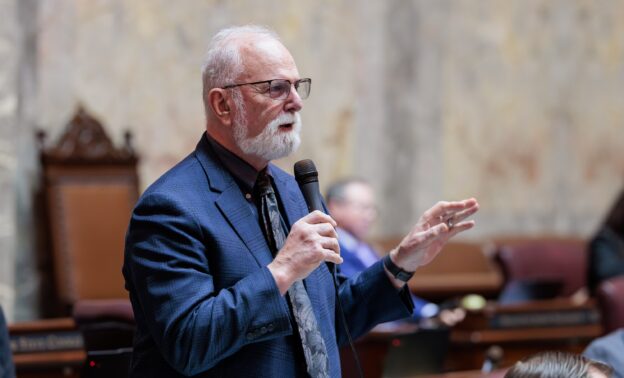
During Senate floor debate on House Bill 1710, Sen. Phil Fortunato, R-Auburn, spoke in opposition to expanding the Washington Voting Rights Act, warning the proposal could create costly bureaucracy and encourage litigation against local election officials.

Fortunato argued the bill could force county auditors to seek approval from the Attorney General’s Office for routine election administration decisions, such as moving ballot drop boxes, adjusting voting locations, or making procedural changes in how elections are conducted.

As a member of the Washington State Election Advisory Board, Fortunato said county auditors regularly work with the Secretary of State to review election procedures and ensure secure, transparent elections across Washington’s 39 counties. Requiring additional approvals from the Attorney General, he said, would create unnecessary red tape and could open the door to a surge of lawsuits.

Fortunato also raised concerns about the potential cost to taxpayers, noting that enforcing the policy could require significant legal resources from the Attorney General’s Office.

“This is not protecting democracy,” Fortunato said. “It’s creating bureaucracy and encouraging litigation.”